
The Reserve Bank of India (RBI) Governor Sanjay Malhotra is now confronting the classic growth-inflation tradeoff, a situation exacerbated by the West Asia war, which threatens to end the 'goldilocks period' of low inflation and robust growth.

Indian defence stocks have seen an average year-on-year gain of 67 per cent, driven by renewed interest following 'Operation Sindoor' and a broader increase in global geopolitical tensions, with the combined market capitalisation of 18 firms increasing by approximately 2.3 trillion.

Markets face risk of a prolonged bear phase as oil shocks and geopolitical tensions test inflation, growth and investor confidence globally, points out Debashis Basu.
N Chandrasekaran, chairman of Tata Consumer Products (TCPL), stated that India continues to experience credible economic growth, driven by strong demographic fundamentals and accelerating digital public infrastructure, despite a fragmented global landscape.

Piramal Pharma anticipates a significant turnaround in financial year 2026-27 (FY27), projecting early-to-mid teens revenue expansion and a sharp improvement in profitability, driven by improved business momentum, new product acquisitions, and structural tailwinds.

A prolonged supply shock can transmit to lower incomes, and dampen confidence and sentiment, warns Aditi Nayar, chief economist, head-research and outreach, ICRA.

Andhra Pradesh Chief Minister N Chandrababu Naidu has announced incentives for families to encourage larger families and reverse the state's declining population trend.

Williams driver Alex Albon has expressed his support for India's efforts to bring Formula One back to the country, stating it would be 'fantastic' and he would be 'excited' to be part of it.

Major US technology companies, Meta and LinkedIn, are undergoing significant workforce restructuring, with Meta planning to lay off 8,000 employees while shifting 7,000 into AI-focused roles, and LinkedIn cutting over 600 jobs across various departments.

Retail giant Walmart has announced that India has become one of its fastest-growing sourcing hubs globally, with the company having procured over $40 billion worth of goods from the country. This initiative aims to expand supplier capabilities, improve compliance standards, and help Indian manufacturers scale exports worldwide.

Prime Minister Narendra Modi has appealed to citizens to adopt austerity measures, including avoiding destination weddings abroad and reducing edible oil consumption, to mitigate the impact of the West Asia crisis on India's economy.

A foreign brokerage warns that sustained crude oil prices above USD 100 per barrel could push India's inflation above the RBI's tolerance level, potentially triggering interest rate hikes.

The Indian banking sector is projected to experience a steady 9-13 per cent industrial credit growth in the first half of 2026, driven by capital expenditure, infrastructure development, and sectoral demand recovery, according to a Ficci-IBA survey.

Reliance Industries' digital arm, Jio Platforms, may see its initial public offering (IPO) delayed to the second half of fiscal 2027, according to CreditSights. The delay is primarily attributed to ongoing geopolitical tensions in the Middle East, which could impact market conditions and investor sentiment.
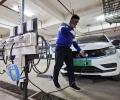
India's electric vehicle (EV) market experienced a significant surge in financial year 2025-26 (FY26), with e4W registrations nearly doubling and e2Ws growing by over 20%, propelled by expanding charging infrastructure, diverse model launches, and accessible financing.

India's eight core infrastructure sectors recorded a two-month high growth of 1.7 per cent in April, primarily boosted by strong performances in steel, cement, and electricity production, according to government data.

Moody's Ratings has downgraded India's growth forecast for financial year 2026-27 (FY27) to 6 per cent from 6.8 per cent, attributing the revision to weaker consumption and industrial activity, elevated energy prices, and rising input costs stemming from the West Asia conflict.

The United Nations has revised downward India's economic growth forecast for 2026 to 6.4 per cent from an earlier 6.6 per cent, attributing the change to global uncertainties and economic shocks stemming from the ongoing West Asia crisis.
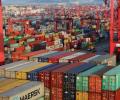
India's exports recorded a 13.78 per cent increase to USD 43.56 billion in April, marking the highest monthly outbound shipments in over four years, primarily driven by petroleum products. However, the trade deficit widened to a three-month high of USD 28.38 billion due to a 10 per cent rise in imports.

Amidst a sharp run-up in gold and silver prices, investors are advised to rebalance their portfolios by booking partial profits in precious metals and reallocating to domestic equities and debt, according to financial experts.
India's defence sector is on the cusp of a 'super cycle' of growth, driven by escalating geopolitical conflicts and a strong policy push towards indigenous manufacturing, with major players like BEL, HAL, and BDL poised for significant order inflows and technological advancements.

"Our strategy has always been to focus on volume-led penetration growth," said Manish Tiwary, chairman and managing director, Nestle India.
India Ratings and Research predicts the Reserve Bank of India (RBI) will maintain the repo rate at 5.25 per cent throughout FY27, despite potential inflationary pressures from higher fuel prices, with inflation expected to remain within the central bank's tolerance band.

Quick commerce platform Zepto is reportedly planning to launch its Rs 11,000-crore Initial Public Offering (IPO) in July, following SEBI approval. The company is pursuing a distinct growth strategy, focusing on market density and operational intensity in metro markets rather than rapid geographic expansion, a move that sets it apart from rivals like Zomato and Swiggy.

Suzuki Motorcycle India Ltd (SMIPL) has revised its domestic two-wheeler sales growth estimate for FY27 downwards from 7-8 per cent, citing rising commodity costs due to the ongoing West Asia conflict and its impact on consumer affordability.

Net investments into equity mutual fund schemes in India remained elevated at approximately 38,440 crore in April, despite a slight dip from March's high and a 3% month-on-month decline in Systematic Investment Plan (SIP) inflows.

American industry groups sought punitive tariffs on Indian goods at USTR hearings, while Indian officials defended the country's manufacturing growth as demand-led and WTO-compliant.

Hindustan Unilever (HUL) exceeded consensus estimates in Q4FY26, driven by lower overheads and 6 per cent consolidated volume growth. However, the company anticipates further price hikes to counter an expected 8-10 per cent material cost inflation, while maintaining a mid-term margin guidance of 22.5-23.5 per cent.

India emerged reasonably well from 2025. But now, the oil shock and war-related supply disruptions have again driven funds out of India and significantly weakened the rupee, points out Ajay Chhibber.

Tata Motors' MD and CEO, Girish Wagh, has identified rising diesel prices as the most significant threat to India's commercial vehicle (CV) industry recovery, despite the sector recently surpassing its pre-FY19 wholesale peak. Diesel costs account for 25-50% of a truck operator's total cost of ownership, making any increase a critical concern for fleet economics.

Biocon is actively seeking in-licensing opportunities to expand its biosimilars portfolio, focusing on products that complement existing therapy areas, as the company shifts to a 'consolidate' phase with a strong emphasis on improving capacity utilisation, expanding margins, and driving return on capital employed.
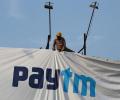
Brokerage firm Jefferies maintains a 'Buy' rating for Paytm, citing its dominant merchant payments platform and projected revenue growth.

Former India captain and coach Rahul Dravid has been named as a co-owner of the Dublin franchise in a new European Twenty20 league, with the 53-year-old being part of an Indian consortium that acquired the team in the tournament set to launch in September.

Bank of Baroda economists project India's GDP to grow 6.5-6.8 per cent in FY27 but warn that the fiscal deficit could overshoot the budgeted 4.3 per cent target, potentially reaching 4.7-4.8 per cent of GDP due to subsidy overruns, excise duty cuts, and oil marketing company losses.

Kiran Mazumdar-Shaw names niece Claire Mazumdar as successor at Biocon. Explore the leadership transition, strategy, and future plans.

India's consumption stocks, which have outperformed the broader market, are now facing significant pressure due to a gradual rise in fuel prices and the potential for higher inflation. Analysts warn that companies may be forced to pass on increased input costs to consumers, potentially hurting demand across both staples and discretionary categories, with a looming threat of deficient monsoon rainfall further exacerbating inflationary concerns.
Fitch Ratings on Friday said persistently higher oil prices could cause India's retail inflation to rise faster than the expected gradual pace, and lead to a slowdown in economic growth in the first half of financial year 2026-27 (FY27).

Trent reported a 20 per cent revenue rebound in Q4FY26, driven by a recovery in like-for-like growth and significant store additions. The company's board has approved raising up to 2,500 crore in equity to fund investments in store network upgrades, new brands, supply chain automation, and Star Bazaar expansion, alongside a 1:2 bonus issue and a 6 dividend.

'Once the currency goes out of the hand, then possibly your major challenge is that it will not come back.'

Bajaj Auto reported a significant increase in its consolidated Q4FY26 performance, with profit after tax more than doubling to approximately 3,662 crore, a 103 per cent year-on-year rise, primarily driven by record volumes, an improved product mix, and the strategic consolidation of Bajaj Auto International Holdings AG (BAIHAG).
 © 2026 Rediff.com - Advertise with us - Disclaimer - Privacy Policy - Sitemap - Feedback - About us - Terms of use - Grievances